
Reference-free automated single-cell cell type annotation#
By 2025, algorithms for automated cell type annotation have proliferated. Omicverse is committed to reducing discrepancies between different algorithms, so we categorize automated annotation methods into two groups: with single-cell reference and without single-cell reference. Each category has its own advantages and disadvantages. In this tutorial, we will only cover usage and will not compare different algorithms.
This chapter focuses on no single-cell reference approaches, meaning cell type annotation can be performed without downloading existing single-cell datasets.
import scanpy as sc
import omicverse as ov
ov.plot_set(font_path='Arial')

# Enable auto-reload for development
%load_ext autoreload
%autoreload 2
🔬 Starting plot initialization...
Using already downloaded Arial font from: /tmp/omicverse_arial.ttf
Registered as: Arial
🧬 Detecting GPU devices…
✅ NVIDIA CUDA GPUs detected: 1
    • [CUDA 0] NVIDIA H100 80GB HBM3
      Memory: 79.1 GB | Compute: 9.0

   ____            _     _    __
  / __ \____ ___  (_)___| |  / /__  _____________
 / / / / __ `__ \/ / ___/ | / / _ \/ ___/ ___/ _ \
/ /_/ / / / / / / / /__ | |/ /  __/ /  (__  )  __/
\____/_/ /_/ /_/_/\___/ |___/\___/_/  /____/\___/

🔖 Version: 2.1.2rc1   📚 Tutorials: https://omicverse.readthedocs.io/
✅ plot_set complete.
Data preprocess#
Load Dataset#
To quickly demonstrate our capability for reference-free cell type annotation, we utilize the classic pbmc3k dataset. You can import it directly using omicverse.datasets.pbmc3k or download it via the link: https://falexwolf.de/data/pbmc3k_raw.h5ad.
adata=ov.datasets.pbmc3k()
adata
 Loading PBMC 3k dataset (raw)
⚠️ File ./data/pbmc3k_raw.h5ad already exists
 Loading data from ./data/pbmc3k_raw.h5ad
✅ Successfully loaded: 2700 cells × 32738 genes
AnnData object with n_obs × n_vars = 2700 × 32738
    var: 'gene_ids'
Lazy Preprocess#
Since the single dataset lacks batch effects, we directly applied the default processing workflow from omicverse for preprocessing.
#quantity control
adata=ov.pp.qc(adata,
              tresh={'mito_perc': 0.05, 'nUMIs': 500, 'detected_genes': 250})
#normalize and high variable genes (HVGs) calculated
adata=ov.pp.preprocess(adata,mode='shiftlog|pearson',n_HVGs=2000,target_sum=1e4)

#save the whole genes and filter the non-HVGs
adata.raw = adata
adata = adata[:, adata.var.highly_variable_features]

#scale the adata.X
ov.pp.scale(adata)

#Dimensionality Reduction
ov.pp.pca(adata,layer='scaled',n_pcs=50)

#Neighbourhood graph construction
ov.pp.neighbors(adata, n_neighbors=15, n_pcs=50,
               use_rep='scaled|original|X_pca')

#clusters
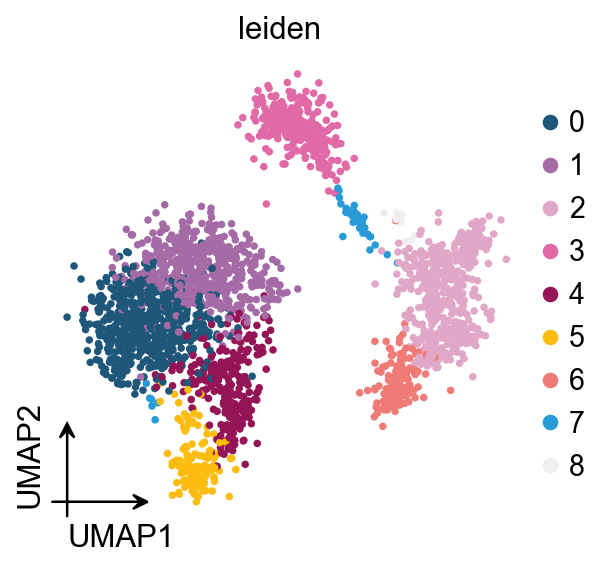
ov.pp.leiden(adata)

#Dimensionality Reduction for visualization(X_mde=X_umap+GPU)
ov.pp.umap(adata)
adata
🖥️ Using CPU mode for QC...
Auto-detected mitochondrial prefix: 'MT-'
📊 Step 1: Calculating QC Metrics
✓ Gene Family Detection:
┌──────────────────────────────┬────────────────────┬────────────────────┐
│ Gene Family │ Genes Found │ Detection Method │
├──────────────────────────────┼────────────────────┼────────────────────┤
│ Mitochondrial │ 13 │ Auto (MT-) │
├──────────────────────────────┼────────────────────┼────────────────────┤
│ Ribosomal │ 106 │ Auto (RPS/RPL) │
├──────────────────────────────┼────────────────────┼────────────────────┤
│ Hemoglobin │ 13 │ Auto (regex) │
└──────────────────────────────┴────────────────────┴────────────────────┘
✓ QC Metrics Summary:
┌─────────────────────────┬────────────────────┬─────────────────────────┐
│ Metric │ Mean │ Range (Min - Max) │
├─────────────────────────┼────────────────────┼─────────────────────────┤
│ nUMIs │ 2367 │ 548 - 15844 │
├─────────────────────────┼────────────────────┼─────────────────────────┤
│ Detected Genes │ 847 │ 212 - 3422 │
├─────────────────────────┼────────────────────┼─────────────────────────┤
│ Mitochondrial % │ 2.2% │ 0.0% - 22.6% │
├─────────────────────────┼────────────────────┼─────────────────────────┤
│ Ribosomal % │ 34.9% │ 1.1% - 59.4% │
├─────────────────────────┼────────────────────┼─────────────────────────┤
│ Hemoglobin % │ 0.0% │ 0.0% - 1.4% │
└─────────────────────────┴────────────────────┴─────────────────────────┘
📈 Original cell count: 2,700
🔧 Step 2: Quality Filtering (SEURAT)
Thresholds: mito≤0.05, nUMIs≥500, genes≥250
📊 Seurat Filter Results:
• nUMIs filter (≥500): 0 cells failed (0.0%)
• Genes filter (≥250): 3 cells failed (0.1%)
• Mitochondrial filter (≤0.05): 57 cells failed (2.1%)
✓ Filters applied successfully
✓ Combined QC filters: 60 cells removed (2.2%)
🎯 Step 3: Final Filtering
Parameters: min_genes=200, min_cells=3
Ratios: max_genes_ratio=1, max_cells_ratio=1
✓ Final filtering: 0 cells, 19,041 genes removed
🔍 Step 4: Doublet Detection
⚠️ pyscdblfinder is not installed; falling back to 'scrublet'.
💡 Install with: `pip install pyscdblfinder` to use the new default.
⚠️ Note: 'scrublet' detection is too old and may not work properly
💡 Consider using 'doublets_method=scdblfinder' (default) for better results
🔍 Running scrublet doublet detection...
🔍 Running Scrublet Doublet Detection:
Mode: cpu
Computing doublet prediction using Scrublet algorithm
🔍 Filtering genes and cells...
🔍 Filtering genes...
Parameters: min_cells≥3
✓ Filtered: 0 genes removed
🔍 Filtering cells...
Parameters: min_genes≥3
✓ Filtered: 0 cells removed
🔍 Normalizing data and selecting highly variable genes...
🔍 Count Normalization:
Target sum: median
Exclude highly expressed: False
✅ Count Normalization Completed Successfully!
✓ Processed: 2,640 cells × 13,697 genes
✓ Runtime: 0.00s
🔍 Highly Variable Genes Selection:
Method: seurat
⚠️ Gene indices [7846] fell into a single bin: normalized dispersion set to 1
💡 Consider decreasing `n_bins` to avoid this effect
✅ HVG Selection Completed Successfully!
✓ Selected: 1,738 highly variable genes out of 13,697 total (12.7%)
✓ Results added to AnnData object:
• 'highly_variable': Boolean vector (adata.var)
• 'means': Float vector (adata.var)
• 'dispersions': Float vector (adata.var)
• 'dispersions_norm': Float vector (adata.var)
🔍 Simulating synthetic doublets...
🔍 Normalizing observed and simulated data...
🔍 Count Normalization:
Target sum: 1000000.0
Exclude highly expressed: False
✅ Count Normalization Completed Successfully!
✓ Processed: 2,640 cells × 1,738 genes
✓ Runtime: 0.00s
🔍 Count Normalization:
Target sum: 1000000.0
Exclude highly expressed: False
✅ Count Normalization Completed Successfully!
✓ Processed: 5,280 cells × 1,738 genes
✓ Runtime: 0.01s
🔍 Embedding transcriptomes using PCA...
📊 Scrublet PCA input data type (CPU) - X_obs: ndarray, shape: (2640, 1738), dtype: float64
📊 Scrublet PCA input data type (CPU) - X_sim: ndarray, shape: (5280, 1738), dtype: float64
🔍 Calculating doublet scores...
🔍 Calling doublets with threshold detection...
📊 Automatic threshold: 0.326
📈 Detected doublet rate: 1.3%
🔍 Detectable doublet fraction: 34.0%
📊 Overall doublet rate comparison:
• Expected: 5.0%
• Estimated: 3.9%
✅ Scrublet Analysis Completed Successfully!
✓ Results added to AnnData object:
• 'doublet_score': Doublet scores (adata.obs)
• 'predicted_doublet': Boolean predictions (adata.obs)
• 'scrublet': Parameters and metadata (adata.uns)
✓ Scrublet completed: 35 doublets removed (1.3%)
╭─ SUMMARY: qc ──────────────────────────────────────────────────────╮
│ Duration: 9.3742s │
│ Shape: 2,700 x 32,738 (Unchanged) │
│ │
│ CHANGES DETECTED │
│ ──────────────── │
│ ● OBS │ ✚ cell_complexity (float) │
│ │ ✚ detected_genes (int) │
│ │ ✚ hb_perc (float) │
│ │ ✚ mito_perc (float) │
│ │ ✚ nUMIs (float) │
│ │ ✚ n_counts (float) │
│ │ ✚ n_genes (int) │
│ │ ✚ n_genes_by_counts (int) │
│ │ ✚ passing_mt (bool) │
│ │ ✚ passing_nUMIs (bool) │
│ │ ✚ passing_ngenes (bool) │
│ │ ✚ pct_counts_hb (float) │
│ │ ✚ pct_counts_mt (float) │
│ │ ✚ pct_counts_ribo (float) │
│ │ ✚ ribo_perc (float) │
│ │ ✚ total_counts (float) │
│ │
│ ● VAR │ ✚ hb (bool) │
│ │ ✚ mt (bool) │
│ │ ✚ ribo (bool) │
│ │
╰────────────────────────────────────────────────────────────────────╯
🔍 [2026-05-17 14:55:29] Running preprocessing in 'cpu' mode...
Begin robust gene identification
After filtration, 13697/13697 genes are kept.
Among 13697 genes, 13696 genes are robust.
✅ Robust gene identification completed successfully.
Begin size normalization: shiftlog and HVGs selection pearson
🔍 Count Normalization:
Target sum: 10000.0
Exclude highly expressed: True
Max fraction threshold: 0.2
⚠️ Excluding 0 highly-expressed genes from normalization computation
Excluded genes: []
✅ Count Normalization Completed Successfully!
✓ Processed: 2,605 cells × 13,696 genes
✓ Runtime: 0.12s
🔍 Highly Variable Genes Selection (Experimental):
Method: pearson_residuals
Target genes: 2,000
Theta (overdispersion): 100
✅ Experimental HVG Selection Completed Successfully!
✓ Selected: 2,000 highly variable genes out of 13,696 total (14.6%)
✓ Results added to AnnData object:
• 'highly_variable': Boolean vector (adata.var)
• 'highly_variable_rank': Float vector (adata.var)
• 'highly_variable_nbatches': Int vector (adata.var)
• 'highly_variable_intersection': Boolean vector (adata.var)
• 'means': Float vector (adata.var)
• 'variances': Float vector (adata.var)
• 'residual_variances': Float vector (adata.var)
Time to analyze data in cpu: 0.30 seconds.
✅ Preprocessing completed successfully.
Added:
'highly_variable_features', boolean vector (adata.var)
'means', float vector (adata.var)
'variances', float vector (adata.var)
'residual_variances', float vector (adata.var)
'counts', raw counts layer (adata.layers)
End of size normalization: shiftlog and HVGs selection pearson
╭─ SUMMARY: preprocess ──────────────────────────────────────────────╮
│ Duration: 0.3522s │
│ Shape: 2,605 x 13,697 -> 2,605 x 13,696 │
│ │
│ CHANGES DETECTED │
│ ──────────────── │
│ ● VAR │ ✚ highly_variable (bool) │
│ │ ✚ highly_variable_features (bool) │
│ │ ✚ highly_variable_rank (float) │
│ │ ✚ means (float) │
│ │ ✚ n_cells (int) │
│ │ ✚ percent_cells (float) │
│ │ ✚ residual_variances (float) │
│ │ ✚ robust (bool) │
│ │ ✚ variances (float) │
│ │
│ ● UNS │ ✚ history_log │
│ │ ✚ hvg │
│ │ ✚ log1p │
│ │
│ ● LAYERS │ ✚ counts (sparse matrix, 2605x13696) │
│ │
╰────────────────────────────────────────────────────────────────────╯
╭─ SUMMARY: scale ───────────────────────────────────────────────────╮
│ Duration: 0.1806s │
│ Shape: 2,605 x 2,000 (Unchanged) │
│ │
│ CHANGES DETECTED │
│ ──────────────── │
│ ● LAYERS │ ✚ scaled (array, 2605x2000) │
│ │
╰────────────────────────────────────────────────────────────────────╯
computing PCA🔍
with n_comps=50
🖥️ Using sklearn PCA for CPU computation
🖥️ sklearn PCA backend: CPU computation
📊 PCA input data type: ArrayView, shape: (2605, 2000), dtype: float64
🔧 PCA solver used: arpack
finished✅ (19.61s)
╭─ SUMMARY: pca ─────────────────────────────────────────────────────╮
│ Duration: 19.6219s │
│ Shape: 2,605 x 2,000 (Unchanged) │
│ │
│ CHANGES DETECTED │
│ ──────────────── │
│ ● UNS │ ✚ pca │
│ │ └─ params: {'zero_center': True, 'use_highly_variable': Tr...│
│ │ ✚ scaled|original|cum_sum_eigenvalues │
│ │ ✚ scaled|original|pca_var_ratios │
│ │
│ ● OBSM │ ✚ X_pca (array, 2605x50) │
│ │ ✚ scaled|original|X_pca (array, 2605x50) │
│ │
╰────────────────────────────────────────────────────────────────────╯
🖥️ Using Scanpy CPU to calculate neighbors...
🔍 K-Nearest Neighbors Graph Construction:
Mode: cpu
Neighbors: 15
Method: umap
Metric: euclidean
Representation: scaled|original|X_pca
PCs used: 50
🔍 Computing neighbor distances...
🔍 Computing connectivity matrix...
💡 Using UMAP-style connectivity
✓ Graph is fully connected
✅ KNN Graph Construction Completed Successfully!
✓ Processed: 2,605 cells with 15 neighbors each
✓ Results added to AnnData object:
• 'neighbors': Neighbors metadata (adata.uns)
• 'distances': Distance matrix (adata.obsp)
• 'connectivities': Connectivity matrix (adata.obsp)
╭─ SUMMARY: neighbors ───────────────────────────────────────────────╮
│ Duration: 5.7163s │
│ Shape: 2,605 x 2,000 (Unchanged) │
│ │
│ CHANGES DETECTED │
│ ──────────────── │
│ ● UNS │ ✚ neighbors │
│ │ └─ params: {'n_neighbors': 15, 'method': 'umap', 'random_s...│
│ │
│ ● OBSP │ ✚ connectivities (sparse matrix, 2605x2605) │
│ │ ✚ distances (sparse matrix, 2605x2605) │
│ │
╰────────────────────────────────────────────────────────────────────╯
🖥️ Using Scanpy CPU Leiden...
running Leiden clustering
finished (0.54s)
found 9 clusters and added
'leiden', the cluster labels (adata.obs, categorical)
╭─ SUMMARY: leiden ──────────────────────────────────────────────────╮
│ Duration: 0.5401s │
│ Shape: 2,605 x 2,000 (Unchanged) │
│ │
│ CHANGES DETECTED │
│ ──────────────── │
│ ● OBS │ ✚ leiden (category) │
│ │
│ ● UNS │ ✚ leiden │
│ │ └─ params: {'resolution': 1.0, 'random_state': 0, 'n_itera...│
│ │
╰────────────────────────────────────────────────────────────────────╯
🔍 [2026-05-17 14:55:55] Running UMAP in 'cpu' mode...
🖥️ Using Scanpy CPU UMAP...
🔍 UMAP Dimensionality Reduction:
Mode: cpu
Method: umap
Components: 2
Min distance: 0.5
{'n_neighbors': 15, 'method': 'umap', 'random_state': 0, 'metric': 'euclidean', 'use_rep': 'scaled|original|X_pca', 'n_pcs': 50}
🔍 Computing UMAP parameters...
🔍 Computing UMAP embedding (classic method)...
✅ UMAP Dimensionality Reduction Completed Successfully!
✓ Embedding shape: 2,605 cells × 2 dimensions
✓ Results added to AnnData object:
• 'X_umap': UMAP coordinates (adata.obsm)
• 'umap': UMAP parameters (adata.uns)
✅ UMAP completed successfully.
╭─ SUMMARY: umap ────────────────────────────────────────────────────╮
│ Duration: 0.6801s │
│ Shape: 2,605 x 2,000 (Unchanged) │
│ │
│ CHANGES DETECTED │
│ ──────────────── │
│ ● UNS │ ✚ umap │
│ │ └─ params: {'a': np.float64(0.5830300203414425), 'b': np.f...│
│ │
│ ● OBSM │ ✚ X_umap (array, 2605x2) │
│ │
╰────────────────────────────────────────────────────────────────────╯
AnnData object with n_obs × n_vars = 2605 × 2000
    obs: 'nUMIs', 'mito_perc', 'ribo_perc', 'hb_perc', 'detected_genes', 'cell_complexity', 'n_counts', 'total_counts', 'n_genes', 'n_genes_by_counts', 'pct_counts_mt', 'pct_counts_ribo', 'pct_counts_hb', 'passing_mt', 'passing_nUMIs', 'passing_ngenes', 'doublet_score', 'predicted_doublet', 'leiden'
    var: 'gene_ids', 'mt', 'ribo', 'hb', 'n_cells', 'percent_cells', 'robust', 'highly_variable_features', 'means', 'variances', 'residual_variances', 'highly_variable_rank', 'highly_variable'
    uns: 'scrublet', 'status', 'status_args', 'REFERENCE_MANU', '_ov_provenance', 'history_log', 'log1p', 'hvg', 'pca', 'scaled|original|pca_var_ratios', 'scaled|original|cum_sum_eigenvalues', 'neighbors', 'leiden', 'umap'
    obsm: 'X_pca', 'scaled|original|X_pca', 'X_umap'
    varm: 'PCs', 'scaled|original|pca_loadings'
    layers: 'counts', 'scaled'
    obsp: 'distances', 'connectivities'
ov.pl.umap(
    adata,
    color='leiden'
)
X_umap converted to UMAP to visualize and saved to adata.obsm['UMAP']
if you want to use X_umap, please set convert=False
Automated Annotation#
We have unified all automatic annotation algorithms into the omicverse.single.Annotation class.
obj=ov.single.Annotation(adata)
Celltypist Automated Annotation#
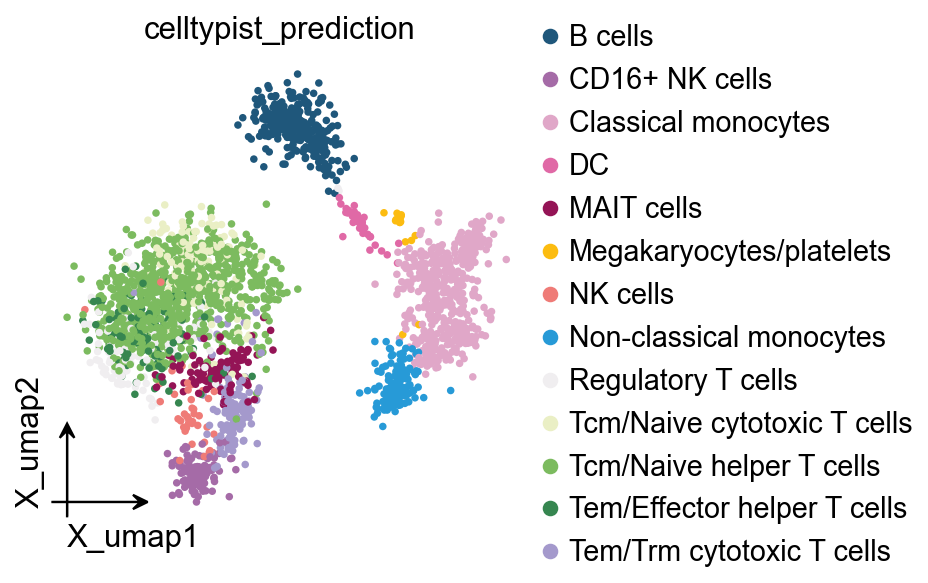
Here, we introduce the first algorithm, Celltypist, published in Cell and Science, which we have integrated into the automatic annotation module of Omicverse. It is important to note that to obtain the optimal pre-trained model, we have incorporated Agent for query processing.
res=obj.query_reference(
    source='celltypist',
    data_desc='pbmc of human',
    llm_model='gpt-5-mini',
    llm_api_key='sk-*',
    llm_provider='openai',
    llm_base_url='https://api.openai.com/v1',
)
res.head()
CellTypist model table saved to self.celltypist_models_df
⚠️ LLM setup failed (Missing API key for LLM provider 'openai'. Provide via `llm_api_key` or set the corresponding environment variable.). Fallback to first model (LLM unavailable or returned no results).
✓ LLM-selected CellTypist models:
  - Immune_All_Low.pkl: Immune_All_Low.pkl
| model | description | version | No_celltypes | source | date | default | llm_reason | |
|---|---|---|---|---|---|---|---|---|
| 0 | Immune_All_Low.pkl | immune sub-populations combined from 20 tissue... | v2 | 98 | https://doi.org/10.1126/science.abl5197 | 2022-07-16 00:20:42.927778 | True | Fallback to first model (LLM unavailable or re... |
Based on the LLM’s recommendation, we found that Immune_All_Low.pkl is the model best suited for our data. Then we use download_reference_pkl function to download this model.
!pwd
/tmp/anno_noref_exec
obj.download_reference_pkl(
    'Immune_All_Low.pkl',
    save_path="/scratch/users/steorra/analysis/omic_test/models/Immune_All_Low.pkl",
    #force_download=True
)
🔍 Downloading data to /scratch/users/steorra/analysis/omic_test/models/Immune_All_Low.pkl
⚠️ File /scratch/users/steorra/analysis/omic_test/models/Immune_All_Low.pkl already exists
https://celltypist.cog.sanger.ac.uk/models/Pan_Immune_CellTypist/v2/Immune_All_Low.pkl
✓ Model saved to /scratch/users/steorra/analysis/omic_test/models/Immune_All_Low.pkl
'/scratch/users/steorra/analysis/omic_test/models/Immune_All_Low.pkl'
After download the model, we need to load it to our Annotation class.
obj.add_reference_pkl('/scratch/users/steorra/analysis/omic_test/models/Immune_All_Low.pkl')
obj.model.cell_types[:5]
array(['Age-associated B cells', 'Alveolar macrophages', 'B cells',
       'CD16+ NK cells', 'CD16- NK cells'], dtype=object)
obj.annotate(
    method='celltypist'
)
Celltypist prediction saved to adata.obs['celltypist_prediction']
Celltypist decision matrix saved to adata.obsm['celltypist_decision_matrix']
Celltypist probability matrix saved to adata.obsm['celltypist_probability_matrix']
ov.pl.embedding(
    obj.adata,
    basis='X_umap',
    color='celltypist_prediction'
)
gpt4celltype Automated Annotation#
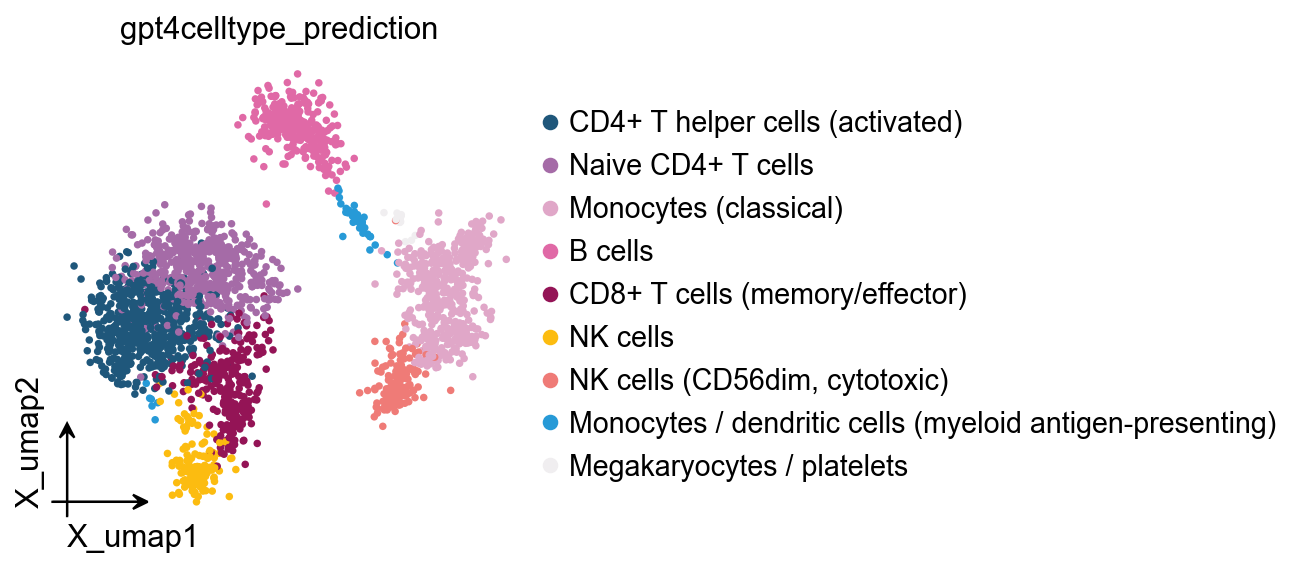
Besides, we also provide the gpt4celltype to annotate the celltype automatically.
import os
# Set AGI_API_KEY before running the notebook; e.g.
#   export AGI_API_KEY=sk-your-actual-key
# See https://platform.deepseek.com/api_keys (DeepSeek) or your
# preferred OpenAI-compatible provider for how to obtain one.
assert os.environ.get('AGI_API_KEY'), (
    'AGI_API_KEY is not set. Export it before running this notebook.'
)

obj=ov.single.Annotation(adata)
result = obj.annotate(
    method='gpt4celltype',
    tissuename='PBMC', speciename='human',
    model='deepseek-chat', provider='openai',
    base_url='https://api.deepseek.com/v1',
    topgenenumber=5
)
...get cell type marker
Note: AGI API key found: returning the cell type annotations.
Note: It is always recommended to check the results returned by GPT-4 in case of AI hallucination, before going to downstream analysis.
GPT4celltype prediction saved to adata.obs['gpt4celltype_prediction']
ov.pl.embedding(
    obj.adata,
    basis='X_umap',
    color='gpt4celltype_prediction'
)
SCSA Automated Annotation#
We haved a clearly detailed tutorial of SCSA in https://omicverse.readthedocs.io/en/latest/Tutorials-single/t_cellanno/
Here, we only provided a simple tutorial to demonstrate the ability of Annotation class.
obj=ov.single.Annotation(adata)
To perform the SCSA automated annotation, we need to download the database at first.
obj.download_scsa_db(
    'temp/pySCSA_2024_v1_plus.db'
)
Trying to download from Stanford...
🔍 Downloading data to temp/pySCSA_2024_v1_plus.db
⚠️ File temp/pySCSA_2024_v1_plus.db already exists
SCSA database saved to temp/pySCSA_2024_v1_plus.db
'temp/pySCSA_2024_v1_plus.db'
obj.add_reference_scsa_db(
    'temp/pySCSA_2024_v1_plus.db'
)
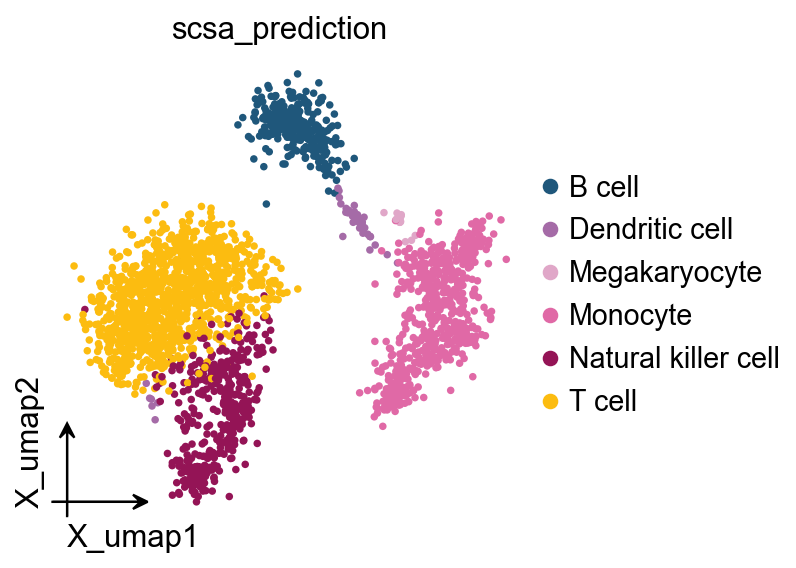
obj.annotate(
    method='scsa',
    cluster_key='leiden',
    foldchange=1.5,
    pvalue=0.01,
    celltype='normal',
    target='cellmarker',
    tissue='All',
)
ranking genes
finished (0:00:00)
...Auto annotate cell
🔍 Version V2.2 [2024/12/18]
📊 DB load: GO_items:47347, Human_GO:3, Mouse_GO:3,
           CellMarkers:82887, CancerSEA:1574, PanglaoDB:24223
           Ensembl_HGNC:61541, Ensembl_Mouse:55414
<omicverse.single._SCSA.Annotator object at 0x7f24bd4cbc70>
🔍 Version V2.2 [2024/12/18]
📊 DB load: GO_items:47347, Human_GO:3, Mouse_GO:3,
           CellMarkers:82887, CancerSEA:1574, PanglaoDB:24223
           Ensembl_HGNC:61541, Ensembl_Mouse:55414
📦 Load markers: 70276

============================================================
🔬 Analyzing 9 clusters...
============================================================
[1/9]      Cluster 0    │ 46   genes │ 978  other genes
[2/9]      Cluster 1    │ 29   genes │ 997  other genes
[3/9]      Cluster 2    │ 337  genes │ 928  other genes
[4/9]      Cluster 3    │ 118  genes │ 937  other genes
[5/9]      Cluster 4    │ 45   genes │ 1005 other genes
[6/9]      Cluster 5    │ 159  genes │ 924  other genes
[7/9]      Cluster 6    │ 433  genes │ 842  other genes
[8/9]      Cluster 7    │ 288  genes │ 877  other genes
[9/9]      Cluster 8    │ 128  genes │ 940  other genes

============================================================
✅ Cluster analysis completed! (9/9 processed)
============================================================


================================================================================
📋 Cell Type Annotation Results
================================================================================

Cluster    Type     Cell Type                           Score           Times
--------------------------------------------------------------------------------
0          ⚠️ ?      T cell|CD4+ T cell                  9.112033735282516|5.2548303193683505 1.73
1          ⚠️ ?      T cell|Naive CD8+ T cell            5.165952802767895|4.4302275893812055 1.17
2          ⚠️ ?      Monocyte|Macrophage                 14.368055481798159|8.508378157687567 1.69
3          ✅ Good   B cell                              13.782018628915111 4.01
4          ⚠️ ?      Natural killer cell|T cell          7.824364750715023|6.636980057576664 1.18
5          ✅ Good   Natural killer cell                 15.297212653962205 3.79
6          ⚠️ ?      Monocyte|Macrophage                 10.834925361082918|8.657124405135688 1.25
7          ⚠️ ?      Dendritic cell|Monocyte             9.410902988033664|6.050426989884969 1.56
8          ✅ Good   Megakaryocyte                       10.227690417346855 2.08
================================================================================

...cell type added to scsa_prediction on obs of anndata
ov.pl.embedding(
    obj.adata,
    basis='X_umap',
    color='scsa_prediction'
)
scMulan Automated Annotation#
scMulan (Bian et al., Nature Methods 2024) is a transformer-based
foundation model trained on a large multi-tissue single-cell atlas. It
predicts a cell-type label per cell directly — no marker dictionary or
reference dataset needed — and is now wired into
ov.single.Annotation alongside celltypist / scsa / gpt4celltype.
The integrated workflow handles three things automatically:
Gene-symbol uniformization —
GeneSymbolUniformrewritesadata.var_namesonto the gene panel scMulan was trained against (defaultuniform_genes=True).Conditional normalisation — if
X.max() > 10the matrix isnormalize_total(1e4) + log1p-ed; otherwise it’s left alone.Optional smoothing pass —
smoothing_threshold=0.1filters false-positive predictions by neighbour consensus (set toNoneto skip).
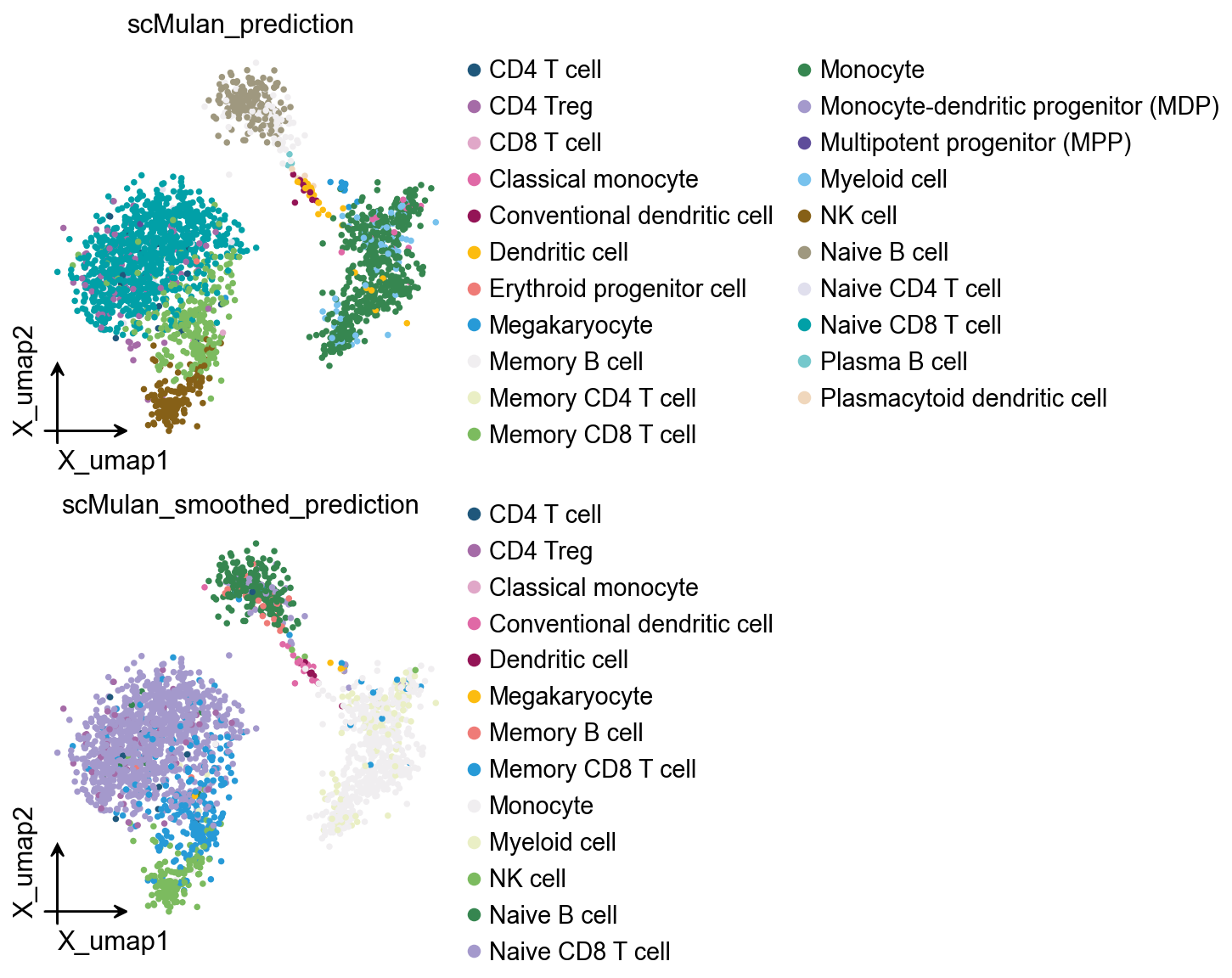
Two prediction columns are written back to adata.obs:
column |
meaning |
|---|---|
|
raw model output |
|
post-hoc neighbour-smoothed label |
obj = ov.single.Annotation(adata)
The checkpoint (≈ 1 GB) lives on the Tsinghua cloud mirror.
download_scmulan_ckpt caches it locally so subsequent runs skip the
download.
obj.download_scmulan_ckpt(
    save_path='./ckpt/ckpt_scMulan.pt',
    # force_download=True,
)
scMulan checkpoint already present at ./ckpt/ckpt_scMulan.pt; pass force_download=True to overwrite.
'./ckpt/ckpt_scMulan.pt'
annotate(method='scMulan') runs gene uniformization, normalisation,
inference, and (by default) the smoothing pass in one call. Pass
parallel=False / n_process=1 to fall back to single-threaded CPU
inference.
obj.annotate(
    method='scMulan',
    smoothing_threshold=0.1,
    parallel=False,        # multi-process hangs on some systems; CPU/GPU single-process is fast enough
)
{message}
The shape of query data is: (2605, 2000)
The length of reference gene_list is: 42117
Performing gene symbol uniform, this step may take several minutes
Building output data, this step may take several minutes
Shape of output data is (2605, 42117). It should have 42117 genes with cell number unchanged.
h5ad file saved in:/tmp/anno_noref_exec/data/scmulan_input_uniformed.h5ad
report file saved in: /tmp/anno_noref_exec/data/scmulan_input_report.csv
number of parameters: 368.80M
✅ adata passed check
👸 scMulan is ready
scMulan is currently available to 1 GPUs.
scMulan prediction saved to adata.obs['scMulan_prediction']
computing neighbors
finished (0:00:00)
scMulan smoothed prediction saved to adata.obs['scMulan_smoothed_prediction']
AnnData object with n_obs × n_vars = 2605 × 2000
    obs: 'nUMIs', 'mito_perc', 'ribo_perc', 'hb_perc', 'detected_genes', 'cell_complexity', 'n_counts', 'total_counts', 'n_genes', 'n_genes_by_counts', 'pct_counts_mt', 'pct_counts_ribo', 'pct_counts_hb', 'passing_mt', 'passing_nUMIs', 'passing_ngenes', 'doublet_score', 'predicted_doublet', 'leiden', 'celltypist_prediction', 'gpt4celltype_prediction', 'scsa_prediction', 'cell_type_from_scMulan', 'cell_type_from_mulan_smoothing', 'smoothing_score'
    uns: 'Smoothing', 'cell_type_from_scMulan_colors', 'cell_type_from_mulan_smoothing_colors'
    obsm: 'X_scMulan'
    obsp: 'Smoothing_distances', 'Smoothing_connectivities'
Visualise the raw vs smoothed scMulan labels side by side.
ov.pl.embedding(
    obj.adata,
    basis='X_umap',
    color=['scMulan_prediction', 'scMulan_smoothed_prediction'],
    ncols=2, frameon='small',
)
MetaTiME Automated Annotation#
MetaTiME (Yan et al., Nature Communications 2023) projects each cell
onto a bank of pre-computed meta-components (MeCs) learned from a large
multi-cancer single-cell atlas, then assigns a tumor-microenvironment
cell-state label per overclustered group. With the new
ov.single.Annotation integration the full workflow — overclustering,
MeC projection, label assignment — is a single call.
column |
meaning |
|---|---|
|
fine cell-state label (e.g. |
|
coarse celltype prefix (e.g. |
|
alias of |
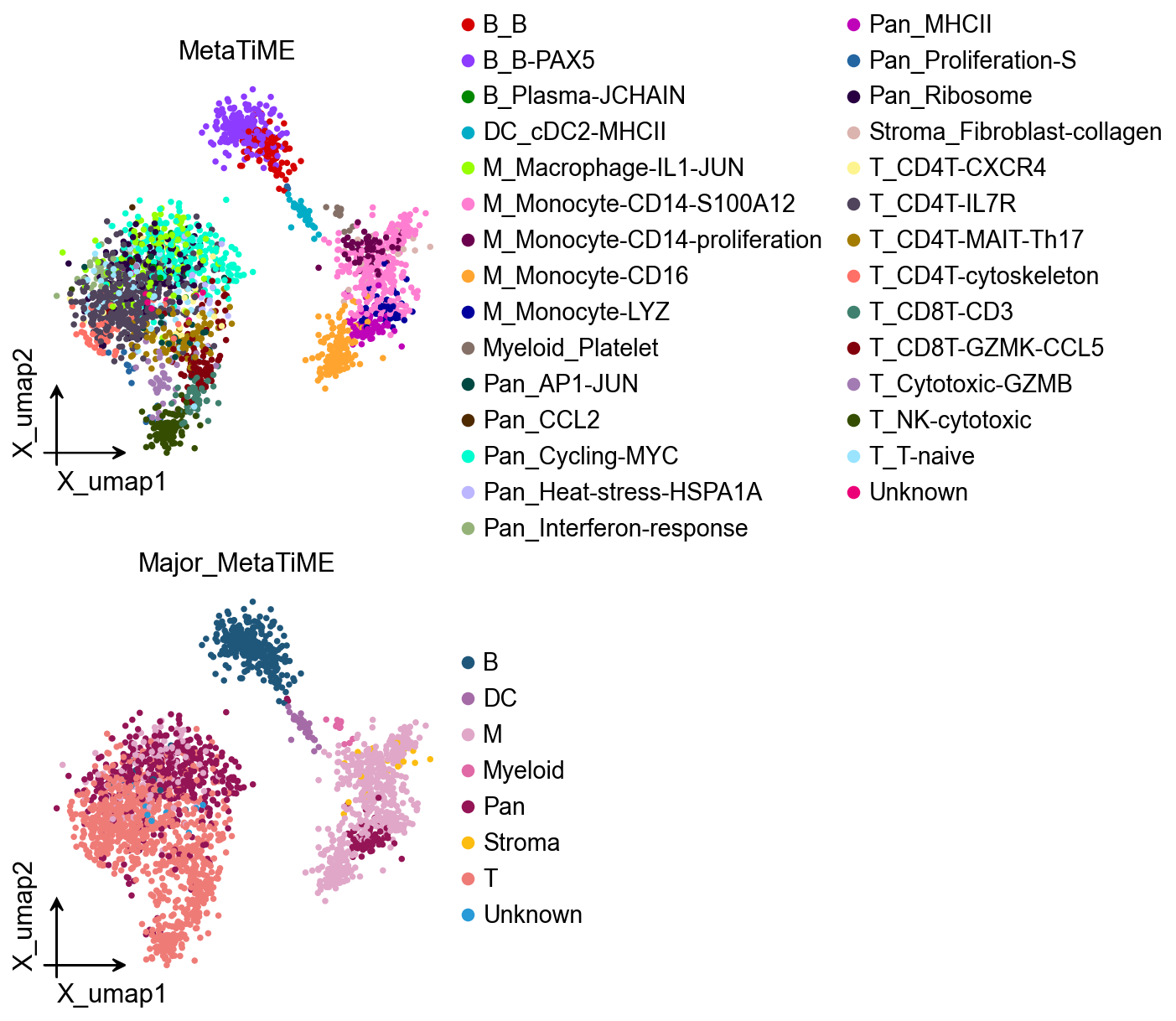
Note: MetaTiME is designed for tumor microenvironment data; PBMC3k is a healthy-blood dataset, so labels will fall back to whichever MeCs are nearest in the gene-program space — useful as a sanity check rather than the model’s intended use case.
obj = ov.single.Annotation(adata)
obj.annotate(
    method='MetaTiME',
    mode='table',
    resolution=8,
    save_obs_name='MetaTiME',
)
metatime have been install version: 1.3.0
...load pre-trained MeCs
...load functional annotation for MetaTiME-TME
...overclustering using leiden
running Leiden clustering
finished (0:00:00)
...projecting MeC scores
......The predicted celltype have been saved in obs.MetaTiME
......The predicted major celltype have been saved in obs.Major_MetaTiME
MetaTiME prediction saved to adata.obs['MetaTiME'] (alias: adata.obs['MetaTiME_prediction'])
<omicverse.single._anno.MetaTiME at 0x7f256340ca30>
Visualise the fine MetaTiME labels and the coarse-grained Major_MetaTiME side by side.
ov.pl.embedding(
    obj.adata,
    basis='X_umap',
    color=['MetaTiME', 'Major_MetaTiME'],
    ncols=2, frameon='small',
)
Save the annotated dataset#
Persist the AnnData with all five annotation columns (celltypist_prediction,
gpt4celltype_prediction, scsa_prediction, scMulan_prediction,
MetaTiME_prediction) so it can be fed directly into the CellVote tutorial.
import os
os.makedirs('result', exist_ok=True)
obj.adata.write('result/pbmc3k_noref_annotated.h5ad')
print(f"saved: result/pbmc3k_noref_annotated.h5ad ({obj.adata.shape[0]} cells)")
saved: result/pbmc3k_noref_annotated.h5ad (2605 cells)