
Differential correlation — DGCA#
Classical differential analysis (metabol.differential) asks which
metabolites change in abundance? Differential correlation asks a
complementary question: which metabolite–metabolite relationships
change between conditions? Two metabolites might have identical mean
levels in both groups yet be tightly co-regulated in one and
uncorrelated in the other — evidence for a rewired pathway.
ov.metabol.dgca implements DGCA (McKenzie et al., BMC
Genomics 2016): Fisher-z transformation of each pair’s correlation
in each condition, z-test on the difference, BH FDR, and a
categorical DC class label (+/+, +/0, +/-, …).
We use the Cachexia dataset — 77 urinary metabolomes labelled
cachexic vs control (47 vs 30).
0 — Setup#
import numpy as np
import pandas as pd
import matplotlib.pyplot as plt
import omicverse as ov

csv_path = ov.datasets.download_data(
    url='https://rest.xialab.ca/api/download/metaboanalyst/human_cachexia.csv',
    file_path='human_cachexia.csv',
    dir='metabol_demo',
)
adata = ov.metabol.read_metaboanalyst(csv_path, group_col='Muscle loss')
adata = ov.metabol.impute(adata, method='qrilc', seed=0)
adata = ov.metabol.normalize(adata, method='pqn')
adata = ov.metabol.transform(adata, method='log')
adata
🔍 Downloading data to metabol_demo/human_cachexia.csv
⚠️ File metabol_demo/human_cachexia.csv already exists
AnnData object with n_obs × n_vars = 77 × 63
    obs: 'group'
    var: 'missing_frac'
    uns: 'metabol'
    layers: 'raw'
1 — Run DGCA#
For 63 metabolites we get 63*62/2 = 1953 pairs. Use Spearman for
metabolomics (heavy-tailed distributions) and threshold |r|≥0.3 for
class labels (the default, matching MetaboAnalyst’s network module).
dc = ov.metabol.dgca(
    adata,
    group_col='group',
    group_a='cachexic', group_b='control',
    method='spearman',
    abs_r_threshold=0.3,
)
print(f'{len(dc)} pairs tested')
dc.head(15)
1953 pairs tested
               feature_a            feature_b       r_a       r_b    z_diff  \
0                Citrate              Glycine  0.351989  0.856285 -3.728665
1          Dimethylamine            Succinate  0.450278 -0.410456  3.768224
2                Lactate              Taurine  0.078978 -0.713014  3.977756
3         2-Oxoglutarate            Glutamine -0.019832  0.666741 -3.373402
4       3-Indoxylsulfate       Guanidoacetate  0.296369 -0.472303  3.348357
5              Histidine         Trigonelline  0.209644 -0.531924  3.295424
6         Guanidoacetate  tau-Methylhistidine  0.346438 -0.407341  3.247102
7                Acetone             Tyrosine  0.286193 -0.421580  3.043459
8                Betaine         Ethanolamine -0.257285  0.450945 -3.064152
9            Methylamine      Methylguanidine  0.272036 -0.434483  3.045276
10          Ethanolamine        cis-Aconitate  0.463344 -0.228921  3.004948
11               Alanine             Tyrosine  0.065796  0.653838 -2.929152
12            Asparagine  N,N-Dimethylglycine -0.254170  0.426029 -2.924320
13               Glucose            Histidine  0.074931 -0.568854  2.948854
14  1-Methylnicotinamide         Trigonelline  0.011506 -0.580868  2.762240

      pvalue      padj dc_class
0   0.000192  0.125315      +/+
1   0.000164  0.125315      +/-
2   0.000070  0.125315      0/-
3   0.000742  0.317527      0/+
4   0.000813  0.317527      0/-
5   0.000983  0.319879      0/-
6   0.001166  0.325277      +/-
7   0.002339  0.456759      0/-
8   0.002183  0.456759      0/+
9   0.002325  0.456759      0/-
10  0.002656  0.471608      +/0
11  0.003399  0.481568      0/+
12  0.003452  0.481568      0/+
13  0.003190  0.481568      0/-
14  0.005741  0.509612      0/-
2 — DC class distribution#
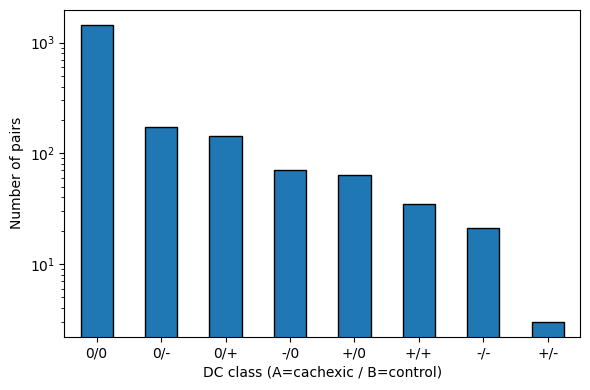
Each pair gets a two-symbol label A/B where +/-/0 summarise the
correlation strength in groups cachexic (A) and control (B):
class_counts = dc['dc_class'].value_counts()
class_counts
dc_class
0/0    1444
0/-     173
0/+     143
-/0      71
+/0      63
+/+      35
-/-      21
+/-       3
Name: count, dtype: int64
fig, ax = plt.subplots(figsize=(6, 4))
class_counts.plot.bar(ax=ax, color='C0', edgecolor='k')
ax.set_ylabel('Number of pairs')
ax.set_xlabel('DC class (A=cachexic / B=control)')
ax.set_yscale('log')
plt.xticks(rotation=0)
fig.tight_layout()
plt.show()
3 — Top rewired pairs#
Sort by |z_diff| and inspect the most differentially correlated pairs.
Cachexia (77 samples) has limited power for pairwise inference — with
BH FDR at 5% only strong effects survive; we therefore rank by effect
size rather than filter on padj so the notebook illustrates the
API regardless.
dc_top = dc.copy()
dc_top['abs_z'] = dc_top['z_diff'].abs()
top = dc_top.sort_values('abs_z', ascending=False).head(15)
top[['feature_a', 'feature_b', 'r_a', 'r_b', 'z_diff', 'padj', 'dc_class']]
           feature_a            feature_b       r_a       r_b    z_diff  \
2            Lactate              Taurine  0.078978 -0.713014  3.977756
1      Dimethylamine            Succinate  0.450278 -0.410456  3.768224
0            Citrate              Glycine  0.351989  0.856285 -3.728665
3     2-Oxoglutarate            Glutamine -0.019832  0.666741 -3.373402
4   3-Indoxylsulfate       Guanidoacetate  0.296369 -0.472303  3.348357
5          Histidine         Trigonelline  0.209644 -0.531924  3.295424
6     Guanidoacetate  tau-Methylhistidine  0.346438 -0.407341  3.247102
8            Betaine         Ethanolamine -0.257285  0.450945 -3.064152
9        Methylamine      Methylguanidine  0.272036 -0.434483  3.045276
7            Acetone             Tyrosine  0.286193 -0.421580  3.043459
10      Ethanolamine        cis-Aconitate  0.463344 -0.228921  3.004948
13           Glucose            Histidine  0.074931 -0.568854  2.948854
11           Alanine             Tyrosine  0.065796  0.653838 -2.929152
12        Asparagine  N,N-Dimethylglycine -0.254170  0.426029 -2.924320
21     Pyroglutamate            Succinate  0.503469 -0.149722  2.882995

        padj dc_class
2   0.125315      0/-
1   0.125315      +/-
0   0.125315      +/+
3   0.317527      0/+
4   0.317527      0/-
5   0.319879      0/-
6   0.325277      +/-
8   0.456759      0/+
9   0.456759      0/-
7   0.456759      0/-
10  0.471608      +/0
13  0.481568      0/-
11  0.481568      0/+
12  0.481568      0/+
21  0.509612      +/0
4 — Visualise one rewired pair#
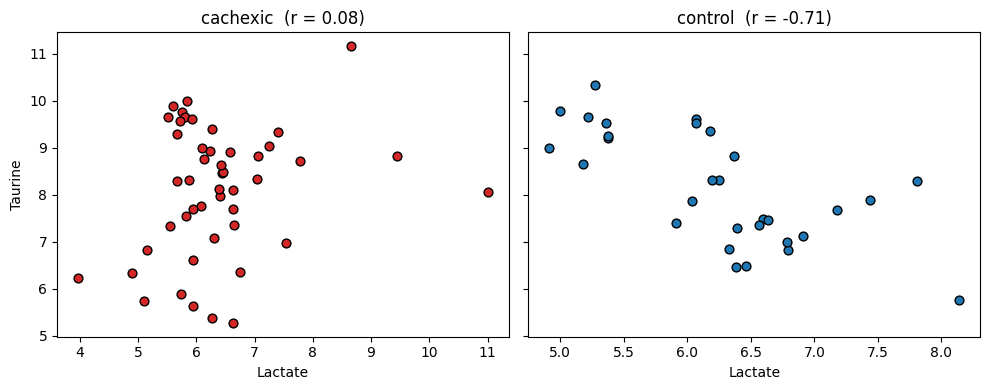
Pick the top pair and show the raw correlation in each group on a scatter plot:
top_row = top.iloc[0]
fa, fb = top_row['feature_a'], top_row['feature_b']
idx_a = list(adata.var_names).index(fa)
idx_b = list(adata.var_names).index(fb)

groups = adata.obs['group'].astype(str).to_numpy()
X = np.asarray(adata.X)

fig, axes = plt.subplots(1, 2, figsize=(10, 4), sharey=True)
for ax, label, colour in zip(axes, ['cachexic', 'control'], ['C3', 'C0']):
    mask = groups == label
    ax.scatter(X[mask, idx_a], X[mask, idx_b], color=colour,
               edgecolor='k', s=40)
    ax.set_xlabel(fa)
    ax.set_title(f'{label}  (r = {(top_row["r_a"] if label == "cachexic" else top_row["r_b"]):.2f})')
axes[0].set_ylabel(fb)
fig.tight_layout()
plt.show()
5 — Rewired correlation network#
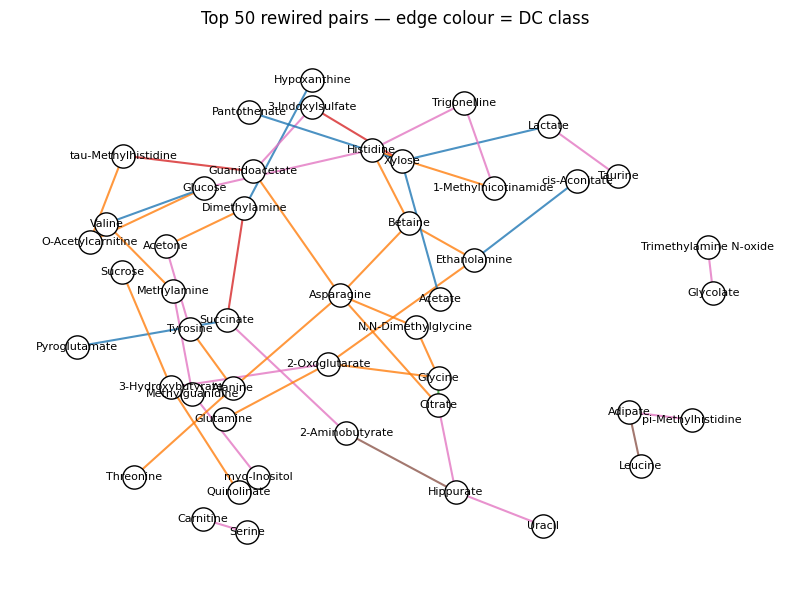
Build a small NetworkX graph of the top-rewired pairs coloured by DC class:
import networkx as nx

top50 = dc_top.sort_values('abs_z', ascending=False).head(50)
G = nx.Graph()
class_colour = {'+/+': 'C2', '-/-': 'C4', '+/-': 'C3', '-/+': 'C3',
                '+/0': 'C0', '0/+': 'C1', '-/0': 'C5', '0/-': 'C6', '0/0': 'lightgray'}
for _, r in top50.iterrows():
    G.add_edge(r['feature_a'], r['feature_b'],
               weight=abs(r['z_diff']),
               color=class_colour.get(r['dc_class'], 'gray'))
pos = nx.spring_layout(G, seed=0, k=0.7)
edge_colors = [G[u][v]['color'] for u, v in G.edges()]
fig, ax = plt.subplots(figsize=(8, 6))
nx.draw_networkx_edges(G, pos, edge_color=edge_colors, width=1.5, alpha=0.8)
nx.draw_networkx_nodes(G, pos, node_size=280, node_color='white',
                        edgecolors='k', ax=ax)
nx.draw_networkx_labels(G, pos, font_size=8, ax=ax)
ax.set_title('Top 50 rewired pairs — edge colour = DC class')
ax.axis('off')
fig.tight_layout()
plt.show()
6 — Static per-condition networks (corr_network)#
DGCA compares conditions. Sometimes you want the static network in each condition on its own — a co-regulation backbone you can visualise, annotate with pathways, or export to Cytoscape.
ov.metabol.corr_network returns a filtered edge list (|r| ≥
threshold, padj < α) for a single condition. Below we build networks
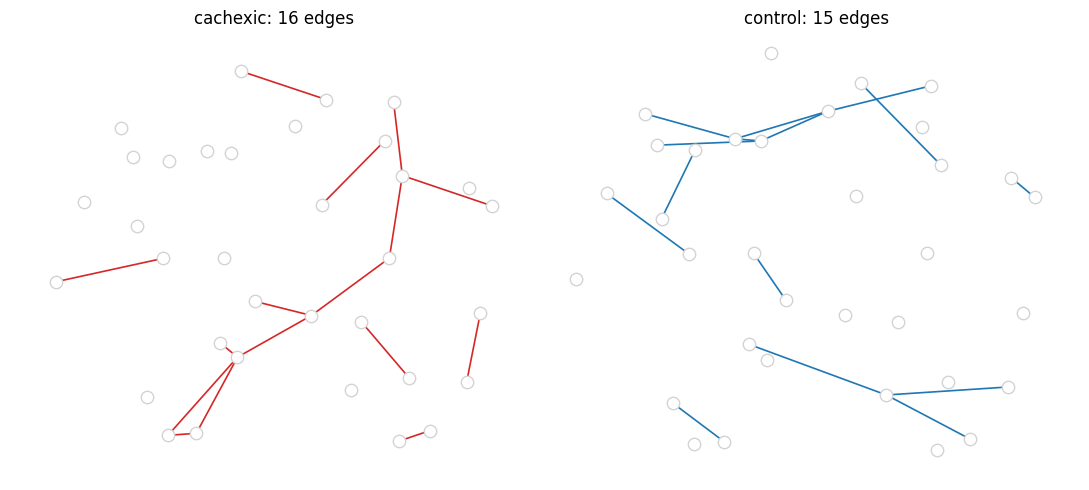
separately for cachexic and control and compare their size / overlap:
edges_ca = ov.metabol.corr_network(
    adata,
    group_col='group', group='cachexic',
    method='spearman',
    abs_r_threshold=0.5, padj_threshold=0.05,
)
edges_ct = ov.metabol.corr_network(
    adata,
    group_col='group', group='control',
    method='spearman',
    abs_r_threshold=0.5, padj_threshold=0.05,
)
print(f'cachexic network : {len(edges_ca)} edges on {edges_ca.attrs["n_samples"]} samples')
print(f'control  network : {len(edges_ct)} edges on {edges_ct.attrs["n_samples"]} samples')

def pair_key(row):
    return frozenset((row['feature_a'], row['feature_b']))

ca_pairs = set(edges_ca.apply(pair_key, axis=1))
ct_pairs = set(edges_ct.apply(pair_key, axis=1))
print(f'shared edges     : {len(ca_pairs & ct_pairs)}')
print(f'cachexic-only    : {len(ca_pairs - ct_pairs)}')
print(f'control-only     : {len(ct_pairs - ca_pairs)}')
cachexic network : 16 edges on 47 samples
control  network : 15 edges on 30 samples
shared edges     : 0
cachexic-only    : 16
control-only     : 15
Top edges in the cachexic network#
edges_ca.head(10)
            feature_a               feature_b         r        pvalue  \
0          Creatinine           Dimethylamine  0.768270  1.583932e-11
1           Carnitine       O-Acetylcarnitine  0.662812  1.209255e-07
2             Glucose                 Lactate  0.609389  2.652975e-06
3             Acetate               Succinate  0.606614  3.059246e-06
4       Dimethylamine  Trimethylamine N-oxide  0.569380  1.794035e-05
5       Dimethylamine           Pyroglutamate  0.564870  2.185967e-05
6      2-Oxoglutarate                 Acetate -0.561748  2.501540e-05
7          Creatinine            Hypoxanthine  0.550994  3.933656e-05
8  pi-Methylhistidine     tau-Methylhistidine  0.526364  1.039705e-04
9             Acetate         Methylguanidine -0.520467  1.295807e-04

           padj
0  3.093420e-08
1  1.180838e-04
2  1.493677e-03
3  1.493677e-03
4  6.979296e-03
5  6.979296e-03
6  6.979296e-03
7  9.603037e-03
8  2.256160e-02
9  2.530712e-02
Venn-like side-by-side#
Plot the two networks with a common layout (union of nodes) so differences in who connects to whom become obvious.
import networkx as nx

all_nodes = list(set(edges_ca['feature_a']) | set(edges_ca['feature_b'])
                 | set(edges_ct['feature_a']) | set(edges_ct['feature_b']))
Gu = nx.Graph()
Gu.add_nodes_from(all_nodes)
for df in (edges_ca, edges_ct):
    for _, r in df.iterrows():
        Gu.add_edge(r['feature_a'], r['feature_b'])
pos = nx.spring_layout(Gu, seed=0, k=0.6)

fig, axes = plt.subplots(1, 2, figsize=(11, 5))
for ax, edges, title, colour in zip(
        axes, [edges_ca, edges_ct],
        ['cachexic', 'control'],
        ['C3', 'C0']):
    G = nx.from_pandas_edgelist(edges,
                                 source='feature_a', target='feature_b',
                                 edge_attr='r')
    nx.draw_networkx_nodes(Gu, pos, node_size=80,
                            node_color='white', edgecolors='lightgray', ax=ax)
    nx.draw_networkx_edges(G, pos, edge_color=colour, width=1.2, ax=ax)
    ax.set_title(f'{title}: {G.number_of_edges()} edges')
    ax.axis('off')
fig.tight_layout()
plt.show()
Takeaways#
DGCA surfaces relationships that
metabol.differentialmisses.The class labels (
+/+,+/0,+/-…) give an interpretable summary:+/0= “correlation gained in A”,+/-= “inversion”.For large panels (
p > 500) restrict withfeatures=<top-N by univariate AUC or VIP>to keep the O(p²) output manageable.
DGCA pairs naturally with ASCA + biomarker panels: they answer different questions about the same data.